


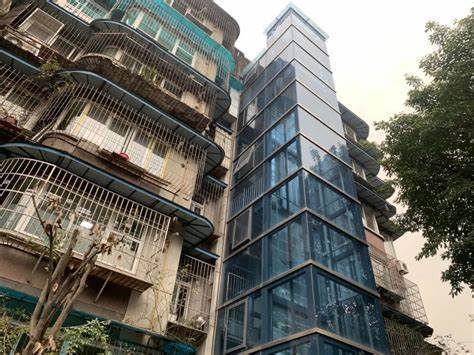
Recently, the community for the installation of elevator issues continue to dispute.
Some people agree to the installation of elevators, while others are firmly opposed to the installation of elevators.
Why would such a situation arise?
At present, most residents are willing to install elevators, and most of the low-floor residents are firmly opposed to the installation of elevators.
First of allOriginally, the lighting and ventilation effect of the low floors was not very good, but now elevators are installed to block the sunlight and air circulation,
SecondlyIn the whole building, the value of low-floor houses lies in travel, and now the installation of elevators will cause the value of low-floor houses to become the bottom of the whole building.
Finally, the lower floors don't use elevators much, but they have to share the elevator costs.
It is for these reasons that there is a great controversy about the installation of elevators in residential areas.
For example, aunt Wang of a certain residential area always feels particularly wronged when she mentions that she has to pay elevator fees to the property every month.
It turns out that Aunt Wang lives on the first floor of the residential area, so she doesn't need to take the elevator to go upstairs at all. There is also a parking lot on the negative first floor underground. Aunt Wang said that she didn't even have a car, so she had to share the elevator fee on the negative first floor!
Owners living on the first floor like Aunt Wang will have similar confusion.At present, there are mainly two views on whether the owner of the first floor needs to pay the elevator fee:
The first one thinks that the residents on the first floor do not need to pay the elevator fee, because the residents on the first floor do not use the elevator, which will not lose electric energy and will not affect the service life of the elevator itself, so it is obviously unfair to let the residents on the first floor pay the elevator fee.
The second opinion is that the residents on the first floor need to pay the elevator fee, because the elevator is a common part of the community, everyone has the obligation to maintain the elevator, and can not refuse to perform the obligation to maintain the normal operation of the elevator on the grounds of not taking the elevator.
So which of the above two opinions is the most reasonable?
Legal Links:
Article 273 of the Civil Code states:
The owner shall have rights and assume obligations to the common parts of the building other than the exclusive parts of the building; he shall not fail to perform his obligations on the grounds of abandoning his rights.

It can be seen that the elevator and the community's flowers and trees, street lights, etc., are common to all owners.
And the elevator operation service will not be because the first floor residents do not take the elevator, the elevator operation and maintenance costs will be significantly reduced, so the first floor residents should bear the same elevator costs as the other floor residents.
In addition,According to Article 1 of the Interpretation of the Supreme People's Court on Several Issues Concerning the Specific Application of Law in the Trial of Property Service Dispute Cases:
If the owner violates the property service contract or laws, regulations, and management regulations, and implements acts that hinder property services and management, and the property service provider requests the owner to bear corresponding civil liabilities such as stopping the infringement, removing the obstruction, and restoring the original state, the people's court shall support it.
In the same situation, Mr. Gu also lived on the first floor and refused to pay the elevator fee on the grounds that he did not use the elevator. The Beijing No. 1 Intermediate People's Court ruled,Mr. Gu paid the property company the full amount of the fees owed.
The court held that although he lived on the first floor, Mr. Gu could not refuse to pay because he signed the property management agreement that "all owners should pay the elevator operating expenses.
Therefore, through the above legal provisions and precedents, it can be seen that the owner of the first floor should pay the elevator fee.

So why should I hand it in?
Perhaps many people, especially the owners on the first floor, are still unconvinced although they know the provisions of the law.
What is the reason or reason why the law stipulates that the owner of the first floor should also pay the elevator fee?
How can we prove that such a provision is good law and not bad law?
The reasonableness of paying elevator fees has at least the following three points:
1. The elevator belongs to the internal channel of the cell and has common attributes. The elevator is a public facility in the community. It is not dedicated to which floor of a building. Express delivery, property maintenance and other social service personnel can be used by anyone. Low-floor residents do not use it. They just give up their rights, but they cannot evade their obligations.
2, low-floor residents in the signing of the purchase contract has accepted the conditions to bear the community public facilities (including elevator fees) related costs. A refusal to undertake is a breach of contract.
3. If the reason for not bearing the elevator fee without using the elevator is established, then most of the land in the whole community is occupied by the residents on the first floor, and the residents on the upper floor can not bear or bear less the land use fee. Obviously, it is not possible.
Source: Sohu News
If there is infringement, contact Li delete