

NEWS
NEWS
Why is it so difficult to install elevators in old residential areas?
2024-05-14
author:
Page view:
Why is it so difficult to install elevators in old residential areas?
At 10 a.m. on January 15, 76-year-old Uncle Wang was sitting on the community corridor chatting with neighbors in Gaojiayuan Community, Chaoyang District, Beijing. It was the first time he had been down in nearly half a month.
The residential area where Lord Wang lives was built in the 1980 s. It is a 6-storey unit building without elevators. He lives on the top floor. Due to the inconvenience of his legs and feet, he basically does not go downstairs. The daily necessities are delivered by his son who lives in the same city every few days.
"If only elevators were installed outside the building, it would be much more convenient to go up and down." Lord Wang is looking forward to it.
Nowadays, in the city, there are more and more elderly people like Uncle Wang who are "difficult to climb the stairs" and "not free to go downstairs. According to statistics from the Ministry of Housing and Urban-Rural Development and other relevant departments, the old houses built from 1980 to 2000 are about 8 billion square meters, and more than 70% of the old buildings lived in by the urban elderly population have no elevators. It is estimated that the number of old buildings in the country that need to be installed with elevators is more than 2 million.
Text irrelevant
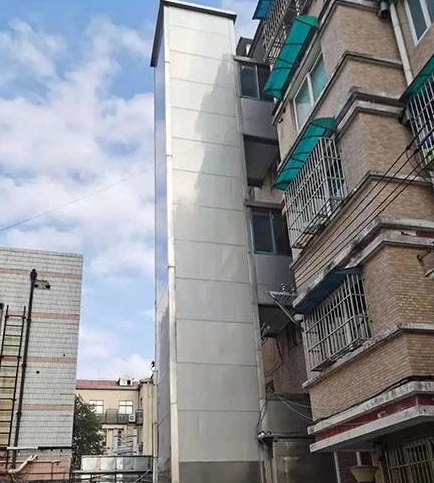
In recent years, the national and local authorities have paid more and more attention to the installation of elevators in old residential areas. According to official sources from the Ministry of Housing and Urban-Rural Development, since 2019, a total of 112000 new urban old communities have been renovated nationwide, and nearly 20000 elevators have been installed in combination with the renovation of old urban communities.
In terms of quantity, the gap in the installation of elevators in old neighborhoods is still large. A recent investigation by a reporter from the Rule of Law Daily found that there are still various problems in practice, such as the installation of elevators, which is difficult to obtain the consent of residents, and some residents refuse to install elevators due to cost-sharing, inconvenience in life, and other reasons. some residents regret the installation of elevators, which leads to many community contradictions and disputes.
Experts interviewed by the reporter agreed that it is necessary to install elevators in old residential areas, but it is also necessary to establish a clearer and understandable policy system and update rules to form a more perfect interest coordination mechanism.
Installation of elevators in old residential areas
High-rise residents praise constantly
Uncle Zhang, who lives in Building 50, Tiantan Dongli, Dongcheng District, Beijing, is luckier than Uncle Wang-the residential unit building where he lives has been equipped with outdoor elevators.
Uncle Zhang is over 70 years old this year. A family of 5 people live on the 6th floor of Unit 4. Before the elevator was installed, everyone in the family was full of complaints about going up and down the stairs: grandson usually finished school and wanted to play with his friends. he always complained that climbing the stairs was tiring and a waste of time. The old couple usually bought vegetables outside or took heavy objects, so it was very difficult to move upstairs.
In 2018, the community installed an outdoor elevator for Unit 4 of the 3., so that residents can go up and down the stairs by swiping their cards, which is much more convenient.
At the end of December 2021, the reporter came to the community to see that in addition to the elevators already built in Unit 4 of the 3., a new exterior elevator was being built between Unit 2 of the 1. A passing resident of a unit said: "We envied them for having elevators before, but now we finally have them, so we don't have to climb the stairs any more."
Reporters randomly interviewed a number of elderly people found that after the installation of elevators in the old residential area, high-level residents received constant praise.
In the Beili Community of Fatou, Chaoyang District, Beijing, the reporter saw that the highest floor of this old community built in the 1980 s is 6 floors. In front of building 16, there are four completed external elevators, and several elevators are under construction in front of building 17.
On the flank of the 17th building, the reporter saw Ms. Han walking downstairs. Ms. Han, 78, lives with her wife on the 4th floor of Unit 3, Building 17. As there was no elevator and it was inconvenient to go up and down the stairs, the son once proposed to buy a house with an elevator for them, but the two elders were reluctant to give up the neighborhood and gave up.
"Fortunately, we are going to install elevators now. For our family, it really saves time, effort and money." Ms. Han said.
According to Yang Qinfa, director of the Institute of Real Estate Policy and Law of East China University of Political Science and Law, the installation of elevators in old communities will not only help alleviate the problem of travel difficulties for the elderly in an aging society, but also a powerful measure to promote the transformation of old communities. At the same time, promoting the installation of elevators in old residential areas is a major livelihood project. In addition to the broad market prospects of the elevator industry, the installation of elevators in old residential areas can also promote the development of the industrial chain related to real estate, which is also of great significance to stimulate residents' consumption.
During the interview, the reporter found that the current mode of installing elevators in old communities is not exactly the same.
When Ms. Wang, who lives on the 6th floor of Unit 2, Building 17, an old community in Xiaodian District, Taiyuan City, Shanxi Province, installed elevators in her community, she used a more traditional way of co-funding by residents. According to Ms. Wang, the government subsidized a lot of funds at that time. Residents on the first to second floors did not bear the installation costs, and the costs shared by residents on the third to sixth floors varied according to the height of the floor, with a maximum of about 18000 yuan. Ms. Wang, as the highest-level household, contributed a total of 18300 yuan.
Beijing Tiantan Dongli Building 50 and Fatou Beili Community are different. It is understood that the residents of these two communities did not spend a penny when installing elevators. After the elevators are built, residents can use the elevator card, just like taking a bus, who takes the elevator and who swipes the card to pay.
In front of the elevator in Building 50 of Tiantan Dongli, the reporter found that non-resident visitors can also take the elevator by scanning the QR code with their mobile phones. The single price is 1.5 yuan, unlimited floors. According to Uncle Zhang, after the residents in the building apply for a card, there will be a "preferential price", ranging from 0.5 yuan to 0.9 yuan depending on the floor. "Our family lives on the top floor, and it costs 0.9 yuan every time we take the elevator. My grandson often goes back and forth after having the elevator. In fact, the cost is not small. Our family spends more than 100 yuan on the elevator every month."
At present, the elevators in the community of Naotou Beili only support the use of credit cards, and foreign visitors cannot take them without cards.
Yang Qinfa said that there are currently three main modes of installing elevators, namely, residents' self-financing and self-construction, agent construction and leasing, and property rights units or collective organizations.
Yang Qinfa believes that among the three ways, the best way for residents is "agent construction and leasing": the construction of elevators is funded by a third party, and residents in the community only need to pay a certain amount of riding fees when using elevators, and the maintenance fees, maintenance fees and electricity charges of elevators are all borne by the third party. This method can better solve the problem of capital contribution among residents, but the difficulty lies in the willingness of the elevator company due to the greater pressure on the elevator company. Therefore, the current owner self-financing self-built this approach is also being implemented.
Many problems can not be ignored
The one-vote veto is controversial.
Although the call for the installation of elevators is strong, the reporter randomly visited 12 old communities in Beijing and Tianjin and found that only 3 elevators have been installed, and the number and proportion are still relatively small, and none of them cover all the residential buildings. In addition, in the area that has been installed or planned to install elevators, there are also residents who have different troubles.
Mr. Liu, 76, a resident on the first floor of Unit 6, Building 16, Beili Community, said: "Everyone is an old neighbor for decades, so when I asked the residents for their opinions on the installation of elevators, I agreed without any hesitation., But after installing the elevator, I encountered some troubles."
Because he lived on the first floor, Mr. Liu immediately felt that the lighting in the room was affected after the elevator was built. At ordinary times, the light in the living room is quite good, but even during the day after the elevator, the lights must be turned on at home, otherwise you can't see clearly.
In addition, the elevator is outside the window of Mr. Liu's kitchen. during the design delay, the elevator stretches out a section of eaves, which is just as high as the window on the first floor. as a result, rainwater will drip into Mr. Liu's kitchen along the eaves when it rains, and the kitchen will become damp over time.
Ms. Wang from Taiyuan also feels that there are some problems: "The elevators in the community are installed outside the building, which takes up a lot of outdoor space, which affects the neatness, cleanliness and beauty of the outdoors, and therefore reduces parking spaces."
Ms. Wang recalled that at that time, the low-rise residents of the next unit did not agree to install elevators because they would reduce the rent and the selling price of second-hand houses. They even asked other residents to compensate, otherwise they would firmly oppose it and make everyone unable to install elevators. "The residents of that unit also quarreled many times because of this, and the neighborhood committee could not mediate, so it was not installed in the end."
It is not uncommon for low-rise tenants to object, resulting in elevators not being installed. In building 16 of beili community, no elevator has been installed in unit 4 of the 2. After seeking confirmation from the residents, the reporter learned that this was because the low-rise residents of the fourth unit of the 2. clearly objected when soliciting the opinions of the residents, so they did not build it at the same time.
It is reported that the current procedures for installing elevators in old residential areas in Beijing mainly refer to the "Beijing Municipal Comprehensive renovation work Manual for Old residential areas" issued by the Beijing Municipal Housing and Construction Commission in April 2020, in which the requirement for soliciting opinions from residents is that "the intention and preliminary plan for installing elevators in existing multi-storey residential buildings should fully listen to the opinions of all owners within the scope of the proposed elevator installation, and with the consent of the owners whose exclusive part accounts for more than 2/3 of the total residential area of the unit and more than 2/3 of the total number of owners, and other owners have no objection".
This also means that once a resident clearly expresses his opposition, even if the proportion of owners who agree reaches the standard, the unit still cannot be equipped with elevators.
For example, Beijing's "one-vote veto" system, which is opposed to total negation on the issue of installing elevators in old residential areas, has been "evaded" in many places through relevant regulations ".
For example, in January 2021, the Shanghai Municipal Housing and Urban-Rural Construction Management Committee and the Shanghai Municipal Housing Administration jointly issued the Notice on Adjusting the Voting Proportion of Owners of Elevators in Existing Multi-storey Residential Buildings in the City, stipulating that applicants should fully negotiate the intention and specific plans of installing elevators, and solicit the opinions of all owners of the building where they are located. Owners with more than 2/3 of the exclusive area and more than 2/3 of owners will participate in the voting, it is agreed by the owners who participate in the voting of the exclusive part with an area of more than 3/4 and the owners who participate in the voting of more than 3/4.
The Interim Measures for the Installation of Elevators in Existing Residential Buildings in Qingdao also stipulates that if the owners cannot reach an agreement after full and friendly negotiation, the owners with more than 2/3 of the exclusive part of the unit (this building) and more than 2/3 of the owners shall participate in the voting, and the owners with more than 3/4 of the exclusive part and more than 3/4 of the owners participating in the voting shall agree and sign a written consent.
According to Yang Qinfa, because the installation of elevators is a major matter related to co-ownership and joint management, in accordance with the provisions of Article 278 of the Civil Code, the statutory voting procedures shall be subject to the participation of the exclusive part of the voting area of more than 3/4 Owners and owners with more than 3/4 voting participants agree. "The above provisions can obviously solve the current situation that residents can block the elevator installation if one person opposes it."
However, Yang Qinfa said that there are more detailed regulations on the installation of elevators in various places. At present, most of them are still based on their local regulations. Whether to adopt the "one vote veto system" on the issue of installing elevators in old residential areas to solicit residents' opinions is still controversial.
Work together to solve problems
Comprehensive protection for the convenience of the people
In recent years, more and more attention has been paid to the installation of elevators in old residential areas. The reporter combed and found that the renovation of old residential areas planned for the 14th five-year Plan of housing in many places involves the installation of elevators. For example, the "14th Five-Year Plan for Urban Housing Development in Jiangsu Province" proposes to "make up for the shortcomings of public services such as childcare, elderly care, and housekeeping, and encourage and support greening renovation and the installation of elevators and barrier-free facilities in existing multi-storey residential buildings." Renovation "; the" 14th Five-Year Plan for Urban Housing Development in Zhejiang Province "proposes to" accelerate the installation of elevators in residential buildings and other measures to vigorously improve the quality ".
Yang Qinfa said that the installation of elevators in old residential areas, on the one hand, involves the different interests and needs of residents in the community, and needs to do a lot of coordination work; on the other hand, it involves complicated examination and approval procedures, for elevator installation enterprises, it is obviously more inclined to engage in elevator installation business of new housing with higher efficiency.
For the further improvement of the installation of elevators in old residential areas, Yang Qinfa proposed that the policy design should be shifted from rule-oriented to goal-oriented in the process of standardization. The service object of urban renewal is residents, so it is particularly important to establish a clear division of powers and responsibilities, standardized operation procedures, easy-to-understand policy system and update rules.
"Compared with the regular policy, the target policy tends to adopt the mode of mobilization governance in the specific implementation process, that is, to pool the main body and resources of the grass-roots administrative system and community governance system as much as possible, which is conducive to promoting the efficient implementation of the policy." Yang Qinfa suggested that in terms of policy design, local governments can start from the following three aspects: further improve the voting rules for installing elevators within the legal framework; determine the compensation basis for related interests, and formulate quantitative compensation standards based on disputed matters, such as Construction noise compensation, etc.; speed up the formulation of elevator installation action guidelines, focusing on common controversial issues in the elevator installation process and technical issues of common concern to residents, prepare relevant action guidelines or operation manuals.
At the same time, he also noticed the problem of the government's responsibility boundary in the process of elevator installation. In the initial stage of urban renewal projects such as the installation of elevators, the government still needs to take the initiative to play a role in organizing and coordinating various forces to form a driving force and demonstration. When the time is ripe, we will gradually withdraw and hand over the "right to speak" to the residents, who will take the initiative to coordinate, declare and promote the project.
"For example, it is difficult for the owners to reach an agreement through consultation on the distribution of related benefits. The relief and compensation mechanism should be improved. For example, it is clear that the approval authority includes the administrative reconsideration agency of the construction, planning, fire protection, housing management and other departments, and establish a professional for the transformation of old communities. Administrative mediation mechanism. In addition, it should also be combined with factors such as the economic level of various regions and the transaction price of second-hand houses to formulate a unified method for residents who benefit from the appreciation of the installation of elevators to compensate residents who depreciate the installation of elevators, and guide the installation of elevators. The profit-making residents compensate the residents whose interests are damaged, which is in line with the principle of fairness and reduces the infringement of the legitimate rights and interests of the damaged residents." Yang Qinfa said.
In terms of funds, Xu Fei, a lawyer from Beijing Yinghe Law Firm, suggested that social capital should be fully introduced and a model of joint participation of multiple funds should be adopted to solve the problem of funding difficulties in adding elevators. At the same time, expand the volume of a single additional elevator project, joint bidding, reduce the cost of a single elevator addition.
For the daily maintenance of elevators, Xu Fei believes that professional elevator maintenance units or property companies should be introduced for trusteeship to strengthen the daily management and maintenance of elevators.
Yang Qinfa also suggested that a mechanism for coordinating interests should be established in the process of co-governance. On the one hand, we can explore the implementation of the "household contracting system" for community neighborhood committee members, go deep into each household in the responsibility area, listen to and collect residents' views and opinions on the installation of elevators, and register them by classification, and reflect them to the government, enterprises, etc. for communication; On the one hand, under the leadership of relevant agencies, the community can build a transformation discussion platform involving neighborhood committees, construction units, and residents' autonomous organizations, it provides an open, fair and just way and opportunity to resolve disputes for the participants who have different opinions.
"The installation of elevators is not achieved overnight, and the process is complex. In the coordination stage of residents' interests, the project approval and publicity stage, the elevator installation and acceptance stage and the later operation and maintenance stage, in order to achieve different goals, multiple subjects need to cooperate with each other." Yang Qinfa said
Source: Rule of Law Daily
If there is infringement, contact Li delete
Keywords:
AVIC Elevator Equipment, AVIC Elevator, Elevator Sales, AVIC Elevator Sales, Elevator Maintenance
Contact us

Address: Emei Mountain Road, Gaoping Industrial Park, Huichuan District, Zunyi City
Public account
Mobile terminal
Copyright © 2024 CHINA AVIATION GUIZHOU ELEVATOR CO.,LTD All Rights Reserved